Chegg vs. AI Homework Solvers: What Students and EdTech Experts Should Choose in 2025
If you were a student back when Chegg dominated the scene (roughly 2005 to 2023), you’re probably feeling the massive shift happening in Education Technology (EdTech) right now.
On one side, you have Chegg — the traditional powerhouse that spent the last decade leading with textbook solutions and human-verified Q&A. But according to a recent CNBC report, – the rise of AI has hit Chegg hard: its stock and revenue have dropped by 33%, falling to $105.1 million from 2023 through Q2 2025.
On the other side are Generative AI Homework Solvers (like: ChatGPT-4o, Claude, and Khanmigo), which have completely reinvented how students learn, understand, and solve problems.
The real question for 2025 isn’t “Who gives the fastest answer?” but “Which tool actually helps students learn better?”
True or False? 🤖
“You need to be a Math Genius to learn Artificial Intelligence.”
At N4GM Academy, we simplify complex tech into fun, logic-based modules for young creators.
View Course RoadmapOnline, you’ll find endless debates about whether students should choose Chegg or AI tools like ChatGPT-4o. But as an EdTech expert – I believe the choice shouldn’t be based on hype or fear — it should be based on data, learning outcomes, and academic integrity.
In this post, I’ll break down what you should choose in 2025, why it matters, and how your choice impacts your academic honesty, so you can make a smart, future-proof decision for your education.
Chegg vs. AI Homework Solvers: Key Differences 2026
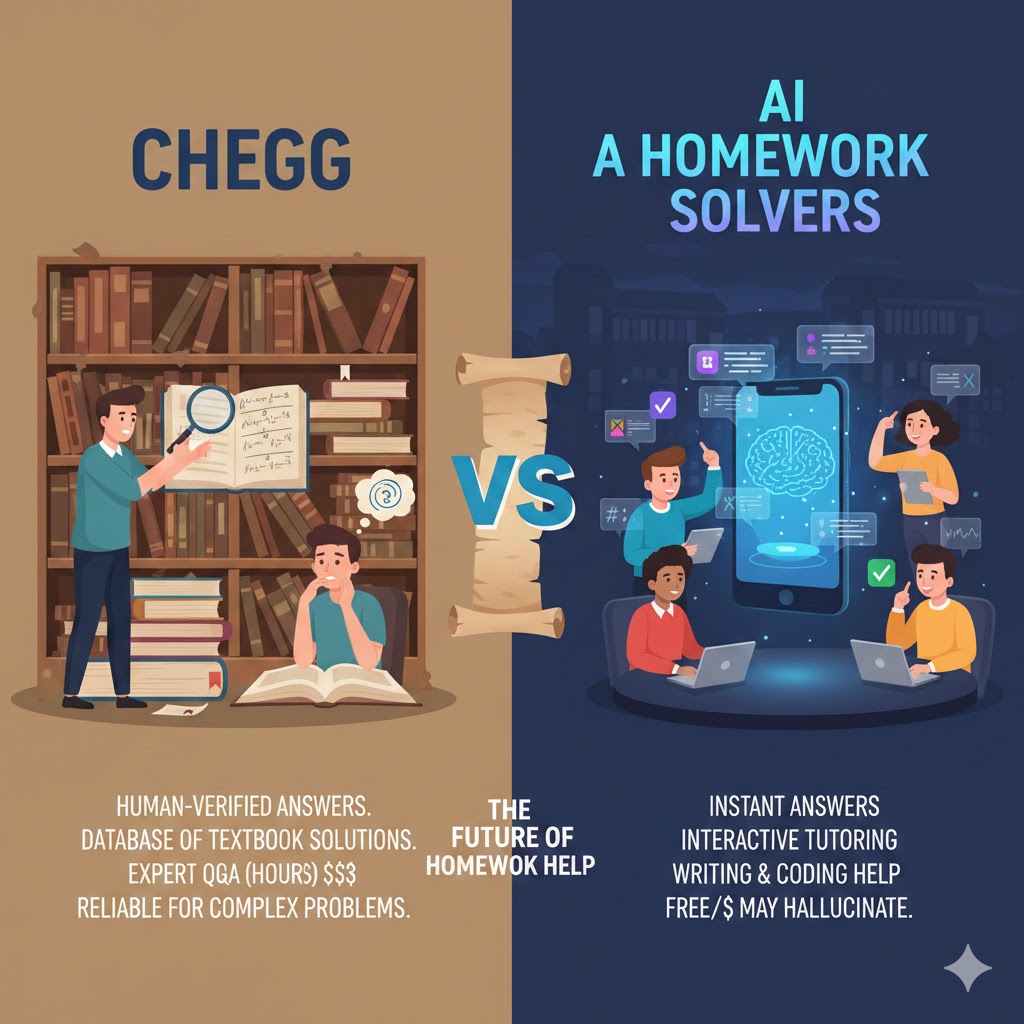
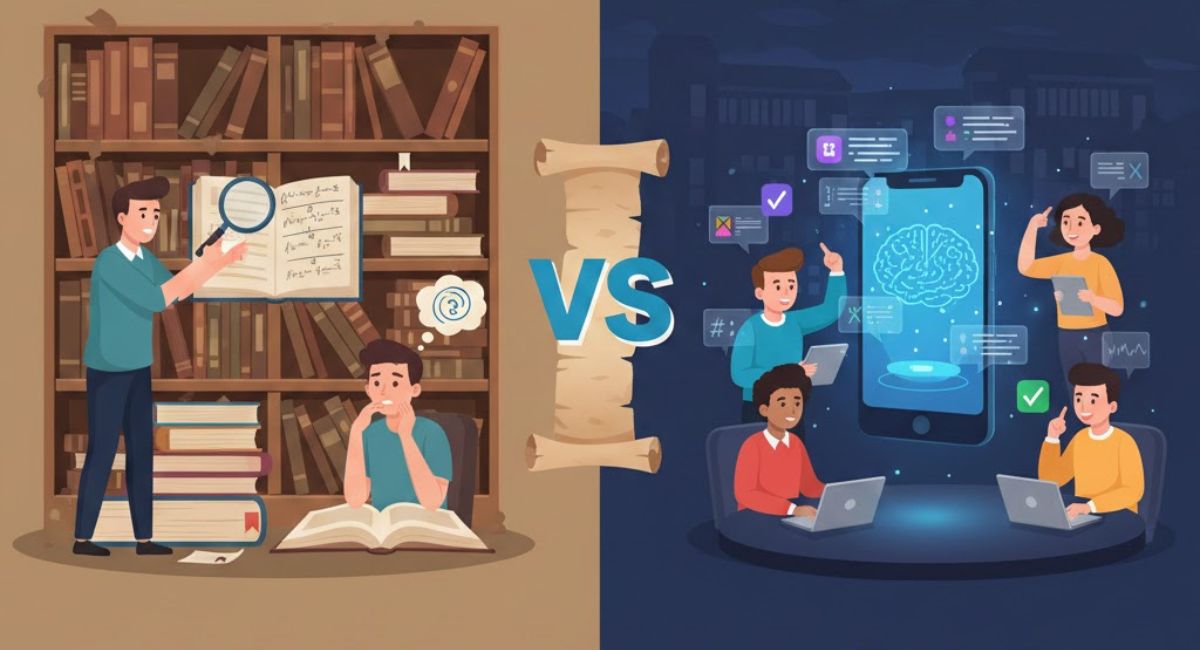
The difference between AI and Chegg isn’t just about the tool; it’s a fundamental distinction between one that gives an answer and one that attempts to teach.
| Factor | Chegg Study (Traditional Model) | AI Homework Solvers (Generative AI) |
|---|---|---|
| Cost / Accessibility | Subscription-based; a significant monthly expense for students. | Often free or available at a very low premium price. Highly accessible. |
| Speed | Depends on human experts; students may wait hours or even days for solutions. | Instant responses with 24/7 availability. |
| Nature of Output | Limited, database-driven, textbook-focused solutions. | Unlimited, creative, conversational, and provides a tutor-like experience. |
| Subject Coverage | Mostly limited to STEM and college-level subjects. | Covers all subjects (Coding, Essay Writing, Humanities) — highly versatile. |
| Learning Style | Gives answers directly; students often copy without understanding. | Explains concepts clearly; more pedagogical and learning-focused. |
The AI Takeover: 3 Reasons Why Chegg Couldn’t Keep Up
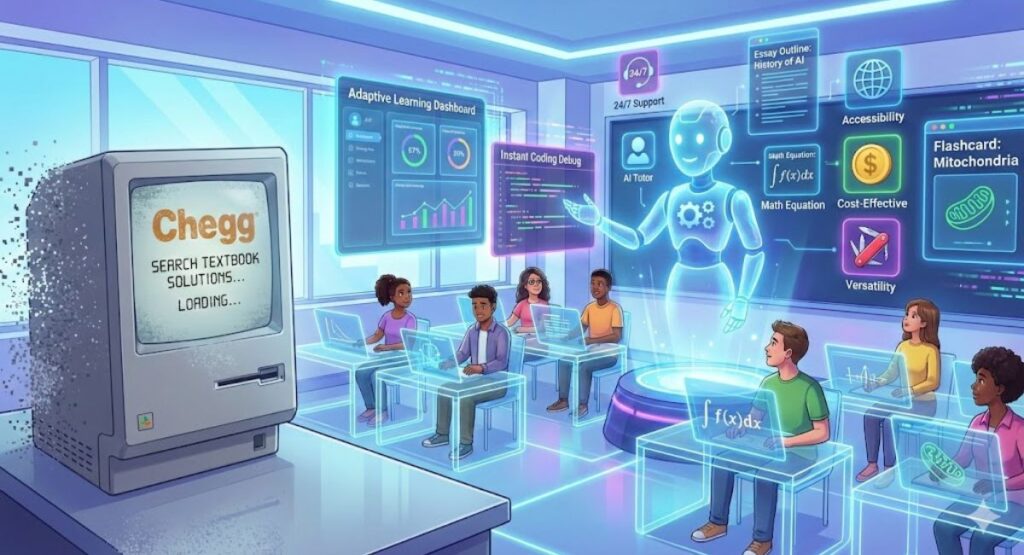
Since AI began expanding (around 2022–2023), or better said, since tools like ChatGPT hit the market — the EdTech world has been shaken to its core. AI hasn’t just overtaken Chegg; it has made the student learning experience far more effective, faster, and deeply personalized.
1. Personalized Learning and Conversational Tutoring
The biggest advantage of AI is its adaptive learning capability. Chegg gives every student the same fixed solution, while AI tailors its guidance to each student’s individual needs.
- Understands the student’s level:
AI analyzes previous answers and conversations to identify where a student is struggling. - Guidance over spoon-feeding:
Tools like Khanmigo (powered by GPT) focus on giving hints and step-by-step guidance instead of simply providing the final answer, encouraging students to solve problems on their own. - A 24/7 Drill Master:
Students can practice any concept, anytime—something that’s simply not possible with a human tutor.
2. Cost-Effectiveness and Accessibility
AI is a game changer when it comes to making education more accessible. Chegg’s monthly subscription fee is a financial barrier for many students.
- Democratization of Education:
Many powerful AI tools are either free or available at a very low cost, helping bridge the learning-resource gap between financially strong and financially disadvantaged students. - A Full-Stack Solution:
AI doesn’t just help with homework—it can summarize notes, create flashcards, generate study plans, and even conduct mock tests. These capabilities go far beyond Chegg’s traditional offerings.
3. Versatility: From Math to Essay Writing
The generative nature of AI allows it to work across an unlimited range of subjects, while Chegg remained mostly confined to STEM and textbook-based solutions.
- Humanities and Writing:
AI can analyze historical events, create structured essay outlines, and provide in-depth interpretations of literary texts. - Coding and Tech:
AI can debug complex coding problems and explain technical concepts clearly, making it a major advantage for tech-focused students.
Academic Integrity, Cheating, and Risks — Dangers Exist on Both Sides
It is a common belief that in this changing world of academic dishonesty, neither side can be entirely justified or condemned. This is because modern educational assistance models have certain inherent flaws.
On the one hand, platforms like Chegg directly encourage cheating, while on the other, AI-based solutions are gradually diminishing students’ critical thinking and problem-solving skills. Indeed, deep concerns have been raised regarding how AI is affecting the students’ ability to think. (Source: Psychology Today)
The Nature of Risk in Both Models:
Chegg Cheating (The Old Method)
- Method: Students often took direct screenshots of Verified Q&A (verified questions and answers) or copied and pasted the answer verbatim.
- Detection: Copy-pasted content of this nature was easily detected by a plagiarism checker (a tool for checking academic theft) because the content already existed on the internet.
- Risk: This was a clear and trackable form of dishonesty.
AI Solvers Cheating (The New Method)
- Method: AI tools can generate a unique, zero-percent-plagiarism essay or code. This content is new and has not beencopied and pasted from any existing source.
- Detection: It is difficult for detection tools to catch such AI-generated content, especially when students make even slight modifications to the AI output.
- Risk: This is a new and more sophisticated form of academic dishonesty, which not only undermines academic integrity but also destroys students’ fundamental learning experience.
Challenges for Educators and AI Detection
Teaching community today is facing unprecedented stress and uncertainty due to AI. Before the widespread availability of AI, during 2022-23 – teachers and subject matter experts received substantial work and income through platforms like Chegg.
However, with the arrival of AI – the entire online educational assistance ecosystem has changed. I spoke with my friends who used to work at Chegg India, and also reviewed Chegg feedback on Mouthshut.
I found – their income has decreased by approximately 50% since the advent of AI because the number of questions they receive has significantly dropped.
This shows that AI has not only changed the methods of student cheating but has also directly impacted the work of professionals providing online knowledge.
Limitations of AI Detection
To combat AI, academic institutions have started relying on AI detection tools. Dedicated instruments like Turnitin and GPTZero have rapidly evolved, but they can never be 100% accurate.
The main reason for this is the continuously changing output style, quality and constant upgrade of AI language models. This causes these detection tools to always lag one step behind.
The current situation can be summarized as follows:
- Turnitin now detects not just plagiarism, but also AI-generated content.
- Dedicated AI detectors like GPTZero have entered the market.
- Today’s Educators are now having to catch not only Plagiarism but also AI misuse, which is a more complex and time-consuming task.
n4gm.com’s Stand: Use AI for Learning, Not for Cheating
As a responsible EdTech specialist, we believe that:
The value of AI tools is not in using them as a Cheat Sheet, but in leveraging them as a Personalized Tutor that explains concepts and enhances critical thinking.Best AI Homework Solvers in 2025
These are the tools that have presented the most significant competition to Chegg in the academic support market.
| Category | Top Tools & Winners | Key Features & Competition Factors |
|---|---|---|
| Math & Science | Photomath + Wolfram Alpha | • Step-by-step detailed logic and reasoning |
| • Comprehensive equation breakdown | ||
| • Advanced features like graphs and proofs | ||
| • Known for high accuracy in STEM fields | ||
| All-in-One Tutoring | ChatGPT 4o + Khanmigo | • Conversational and personalized teaching (Socratic method) |
| • Covers virtually every subject (multi-subject support) | ||
| • Provides real-time hints and adaptive guidance | ||
| • Excels at complex reasoning and contextual understanding | ||
| Writing & Essays | QuillBot + GrammarlyGO | • Tone rewriting and style improvement |
| • Generates summaries and outlines | ||
| • Produces plagiarism-free structured essays | ||
| • Focuses on grammar perfection and clarity |
The Big Shift
These category-specific AI tools are competing directly with Chegg’s traditional model of human expert Q&A. By offering instant, personalized, and continuously available assistance with high accuracy, they force students away from waiting for a human expert, leading to the substantial income drop you mentioned for Chegg experts.
| Tool | Best For | Pricing | Accuracy | Highlights |
|---|---|---|---|---|
| GPT-4o | All subjects | Free/Paid | ⭐⭐⭐⭐⭐ | Human-like reasoning |
| Khanmigo | Learning guidance | Free/Paid | ⭐⭐⭐⭐ | Ethical tutoring |
| Photomath | Math | Free/Paid | ⭐⭐⭐⭐⭐ | Step-by-step logic |
| Wolfram Alpha | Science + Math | Paid | ⭐⭐⭐⭐⭐ | Most accurate engine |
| QuillBot | Writing | Free/Paid | ⭐⭐⭐⭐ | Rewriting + summarizing |
Conclusion: Is the Era of Chegg Over?
The arrival of AI has critically challenged Chegg’s position in the EdTech industry. Chegg may still serve as a backup for Expert-Verified and Textbook-Specific solutions, but its high price tag, slower pace, and lack of Personalized Tutoring pale in comparison to AI.
Our final verdict: AI Homework Solvers are the winners. They represent the future of education—a future that is Personalized, Accessible, and Conversational. Students and parents should now view AI not as a threat, but as a powerful Learning Companion.
After incorporating AI Solvers into your Study Routine, visit our best AI EdTech gadgets to completely transform your classroom!
Academy Insight
We believe that smarter learning starts with the right tools. Our 28-day program is designed to turn curiosity into mastery.

Sachin Sharma is a Tech AI Writer and Chief Editor at N4GM.com, simplifying how AI is transforming education and smart learning since 2019. With deep SEO expertise, he delivers reliable insights on AI learning tools and EdTech trends, helping students and educators navigate the future of technology.