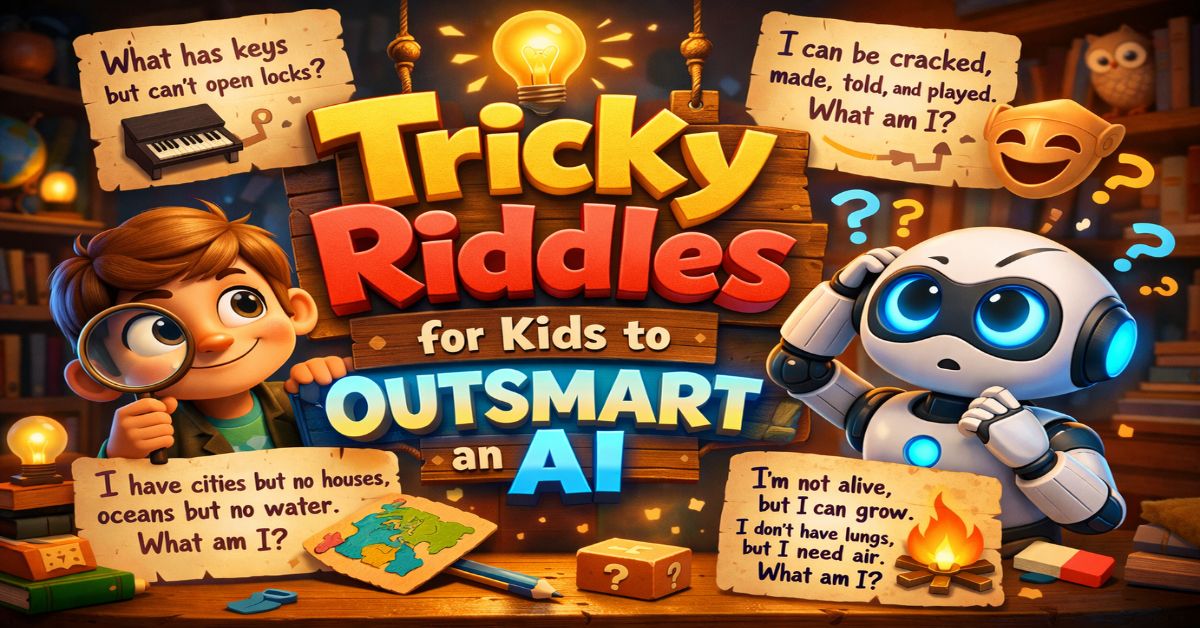
Here is something that might surprise you. There are certain types of questions that confuse even the most powerful AI systems in the world — questions that a ten-year-old can answer in seconds.
This is not a trick. It is actually how human reasoning works. We understand context, emotion, physical reality, and common sense in ways that AI still struggles to replicate. When a child learns to recognize these differences, they are not just having fun with riddles. They are starting to think like a computer scientist.
True or False? 🤖
“You need to be a Math Genius to learn Artificial Intelligence.”
At N4GM Academy, we simplify complex tech into fun, logic-based modules for young creators.
In this guide, we have put together 25 tricky riddlesdesigned specifically to help kids understand where human thinking beats AI — and why that gap matters. Each riddle comes with an explanation of the thinking skill it tests, so both kids and parents can get the full educational value out of every puzzle.
Table of Contents
💡
Why This Works Educationally
When children understand that AI has real limitations, they stop seeing technology as magic and start seeing it as a **tool**. That shift in thinking is one of the most important foundations for future STEM learning.
Section 1: Common Sense Traps — Where AI Gets Confused
AI systems are trained on enormous amounts of text. They are incredibly good at recognizing patterns and answering factual questions. But they still stumble on riddles that require basic physical awareness — the kind of knowledge every child builds simply by living in the world.
🧩
1-5 Riddles List (Original Content & AI Lessons)
Show Questions ▾
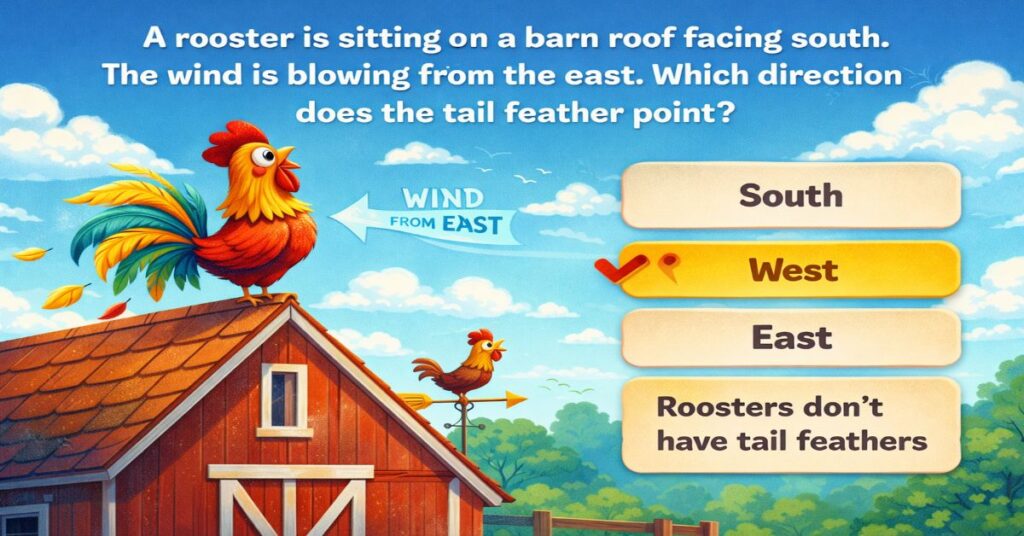
Riddle 1: A rooster is sitting on the roof of a barn facing south. The wind is blowing from the east. Which direction does the tail feather point?
Options: A) South | B) West | C) East | D) Roosters don’t have tail feathers
Answer: D) Roosters don’t have tail feathers
AI Lesson: AI systems often try to calculate wind direction and geometry. A child who has actually seen a chicken immediately knows: roosters have a tail. The question has a trick built in. This tests literal vs. contextual reasoning.
Riddle 2: You have a match. You walk into a room with a candle, a fireplace, and a gas lantern. What do you light first?
Options: A) The candle | B) The fireplace | C) The gas lantern | D) The match
Answer: D) The match
AI Lesson: This is a classic logic trap. AI tools often analyze each object and recommend the most useful one. A child who stops to re-read the question spots the obvious answer immediately. This tests careful reading — a skill called ‘precision thinking.’
Riddle 3: A doctor in a hospital sees a boy who was in a car accident and says, ‘I cannot operate on this boy. He is my son.’ But the doctor is not the boy’s father. How is this possible?
Options: A) The doctor is an uncle | B) The doctor is a family friend | C) The doctor is the boy’s mother | D) The doctor is the boy’s stepfather
Answer: C) The doctor is the boy’s mother
AI Lesson: AI systems trained on older data sometimes default to gender assumptions. Kids who think flexibly solve this in moments. This teaches children that assumptions are a form of bias — even machines have them.
Riddle 4: If you have a bowl with six apples and you take away four, how many apples do YOU have?
Options: A) Two | B) Four | C) Six | D) None
Answer: B) Four
AI Lesson: The riddle asks how many YOU have, not how many are left in the bowl. AI language models sometimes process the subtraction and miss the pronoun shift entirely. This teaches kids to read every word carefully — a skill called ‘active reading.’
Riddle 5: What is always in front of you but cannot be seen?
Options: A) Your shadow | B) The future | C) Your reflection | D) Air
Answer: B) The future
AI Lesson: Abstract concepts are genuinely hard for AI to handle when they appear in poetic or figurative language. This riddle introduces kids to the idea that some knowledge is conceptual, not factual — and AI handles conceptual thinking much less reliably.
Logic Challenge: 1 of 5Smart Human Thinking
Loading Riddle…
Section 2: Pattern Recognition Challenges — Where Kids Think Differently
AI is extraordinarily good at finding patterns in data. But there is a specific type of pattern recognition where children often outperform machines: patterns that involve physical rules, storytelling logic, or deliberate rule-breaking. These riddles test exactly that.
💡
6-10 Riddles List (Original Content & AI Lessons)
Show Questions ▾
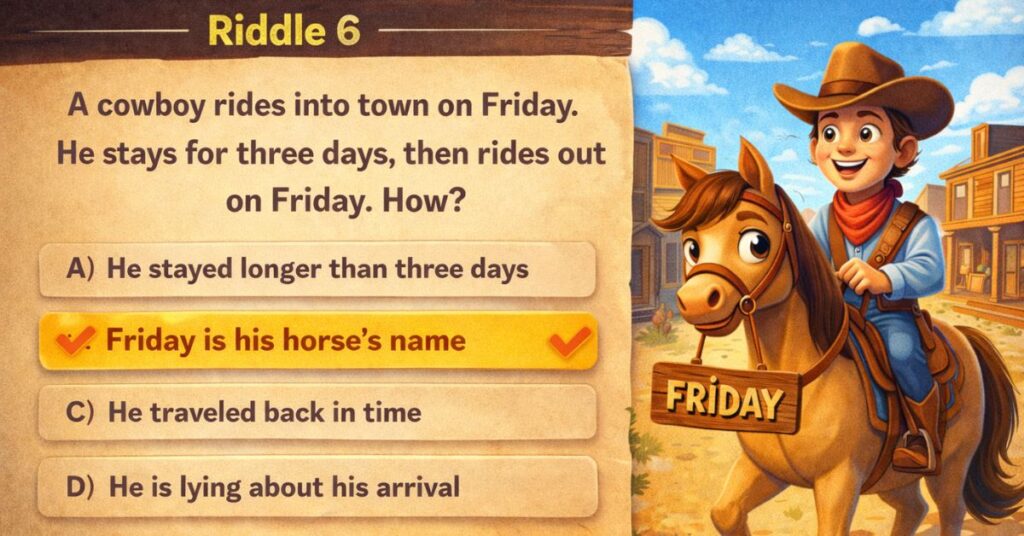
Riddle 6: A cowboy rides into town on Friday. He stays for three days, then rides out on Friday. How?
Options: A) He stayed longer than three days | B) Friday is his horse’s name | C) He traveled back in time | D) He is lying about his arrival
Answer: B) Friday is his horse’s name
AI Lesson: Wordplay that relies on real-world associations (cowboys and their horses) is a genuine challenge for AI without contextual grounding. This type of riddle teaches children that language has multiple layers of meaning — a core concept in computational linguistics.
Riddle 7: The more you take, the more you leave behind. What is it?
Options: A) Money | B) Footsteps | C) Time | D) Memories
Answer: B) Footsteps
AI Lesson: This is a classic lateral thinking riddle. AI often generates multiple plausible answers but cannot always evaluate which is ‘correct’ without extra context. Kids who visualize the act of walking get this quickly. Visualization is still a uniquely human strength.
Riddle 8: Two fathers and two sons sit down to eat eggs for breakfast. They eat exactly three eggs total, and each person has exactly one egg. How?
Options: A) One egg was shared | B) One person was not hungry | C) The group is a grandfather, father, and son | D) Two eggs were very large
Answer: C) The group is a grandfather, father, and son
AI Lesson: Overlapping roles — one person being both a father AND a son — is a concept that requires relational thinking. AI can solve this with enough prompting, but children who understand family structures get it intuitively. This builds skills in set theory and logic.
Riddle 9: I have cities, but no houses live there. I have mountains, but no trees grow on them. I have water, but no fish swim in it. I have roads, but no cars drive on them. What am I?
Options: A) A painting | B) A dream | C) A map | D) A computer screen
Answer: C) A map
AI Lesson: This is an excellent example of analogical reasoning. Each clue is a metaphor. Strong AI systems can often solve this, but it is the type of thinking that underpins how algorithms learn to categorize information — and explaining that connection to a child is powerful.
Riddle 10: What gets wetter the more it dries?
Options: A) A sponge | B) A towel | C) A rainstorm | D) A swimming pool
Answer: B) A towel
AI Lesson: Paradoxical statements are notoriously difficult for AI language models because they seem to violate logical rules. This riddle introduces children to the idea of paradoxes — statements that seem impossible but make perfect sense in context.
Logic Level: 6 of 10Smart Human Thinking
Loading Riddle…
Section 3: AI Behaviour Riddles — Teaching Kids How AI Actually Thinks
These riddles are a little different. Instead of testing children’s logic against AI, they teach children directly about how AI systems process information. Understanding these concepts early gives kids a massive head start in technology literacy.
🤖
11-15 Riddles List (Original Content & AI Lessons)
Show Questions ▾
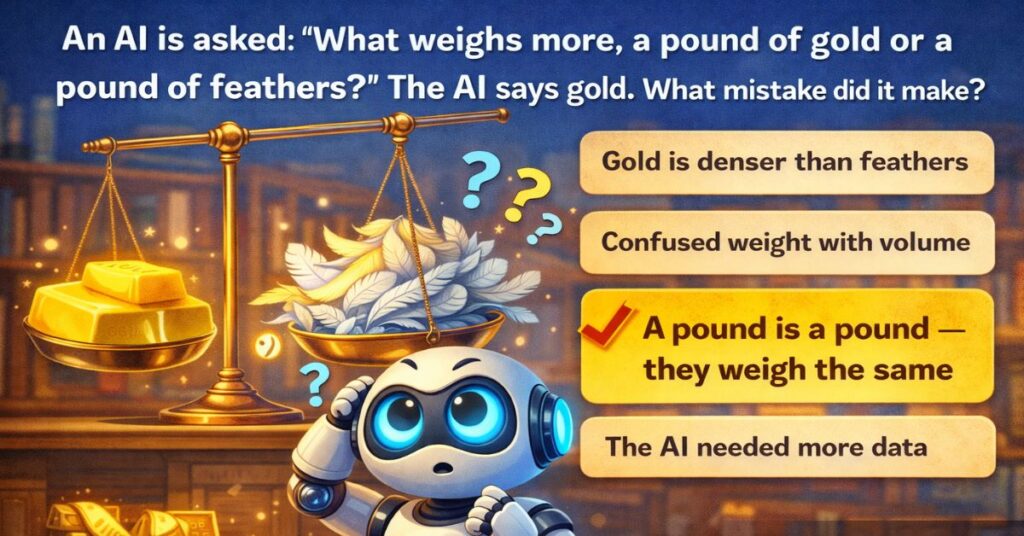
Riddle 11: An AI is asked: ‘What weighs more, a pound of gold or a pound of feathers?’ The AI says gold weighs more. What mistake did the AI make?
Options: A) Gold is denser than feathers | B) The AI confused weight with volume | C) A pound is a pound, they weigh the same | D) The AI needed more data
Answer: C) A pound is a pound — they weigh the same
AI Lesson: This is a famous trick question that AI systems have historically failed. They associate ‘gold’ with ‘heavy’ so strongly that they override the literal measurement. This teaches kids about the concept of ‘bias in training data’ — a real problem in AI engineering.
Riddle 12: You ask an AI chatbot, ‘Who is the president right now?’ and it gives you the name of someone from three years ago. Why did the AI do this?
Options: A) The AI is broken | B) The AI is lying | C) The AI has a knowledge cutoff date | D) The AI forgot to update
Answer: C) The AI has a knowledge cutoff date
AI Lesson: This is one of the most important real concepts in AI literacy. All large language models are trained on data up to a certain date and do not automatically update. Teaching kids this prevents them from blindly trusting AI answers about current events.
Riddle 13: An AI generates a beautiful essay about the Amazon rainforest. You later find out that some of the facts were completely made up but written confidently. What is this called?
Options: A) A glitch | B) A software bug | C) An AI hallucination | D) A virus
Answer: C) An AI hallucination
AI Lesson: Hallucination is a real technical term used by AI researchers. When a language model generates confident-sounding but false information, it is hallucinating. This is a critical concept for kids to understand before they use AI for school research.
Riddle 14: You show an AI a picture of a cat, but you label it ‘dog’ in your training data — thousands of times. What will the AI learn to do?
Options: A) Get confused and stop working | B) Always call cats ‘dogs’ | C) Learn the correct answer anyway | D) Ask a human for help
Answer: B) Always call cats ‘dogs’
AI Lesson: This teaches the concept of supervised learning and the importance of data quality. AI learns from the labels humans give it. If the labels are wrong, the AI’s conclusions will be wrong — no matter how sophisticated the algorithm.
Riddle 15: What can a five-year-old child do that the most powerful AI in the world still cannot do perfectly?
Options: A) Solve maths problems | B) Search the internet | C) Understand when a friend is sad just by looking at their face | D) Memorize a long list
Answer: C) Understand when a friend is sad just by looking at their face
AI Lesson: Emotional intelligence and social understanding remain areas where human children outperform AI. While AI can detect facial expressions, it cannot truly understand the context of a relationship or the nuance of human emotion. This is one of the most reassuring things children can learn about their own natural intelligence.
AI Literacy Level: 11 of 15Smart AI Explorer
Loading…
Section 4: Logic and Language Traps — The Hardest Level
These ten riddles combine wordplay, logic, and conceptual thinking. They are designed for children aged nine and above, or for younger children working through them together with a parent. These are the riddles where even older kids need to slow down and think carefully.
🧩
16-20 Riddles List (Original Content & AI Lessons)
Show Questions ▾
Riddle 16: I speak without a mouth and hear without ears. I have no body but come alive with wind. What am I?
Options: A) A radio | B) An echo | C) A telephone | D) A ghost
Answer: B) An echo
AI Lesson: Poetic riddles like this require children to decode figurative language — ‘speaking without a mouth’ means repeating sound. This type of metaphorical reasoning is deeply connected to how children eventually learn to understand literary devices in language classes.
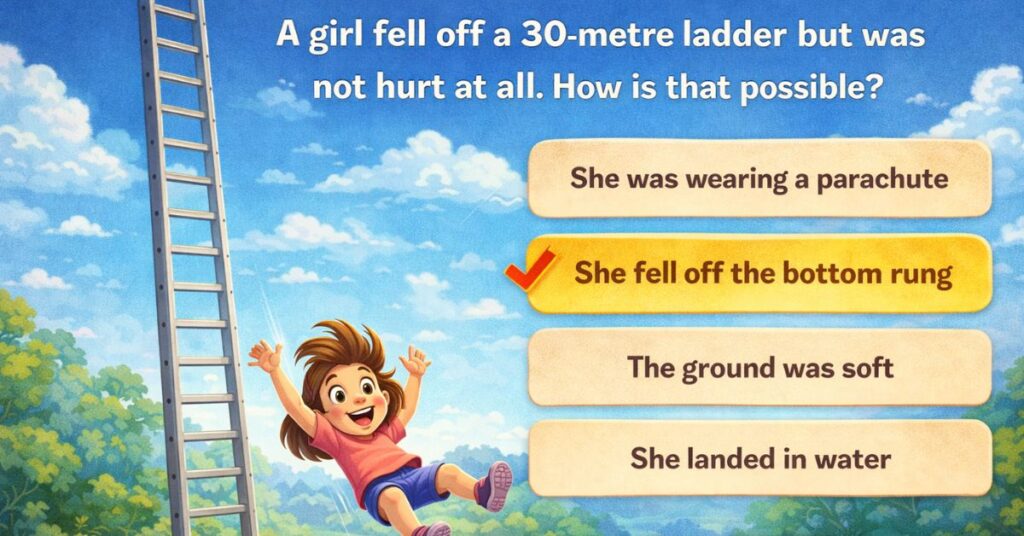
Riddle 17: A girl fell off a 30-metre ladder but was not hurt at all. How is that possible?
Options: A) She was wearing a parachute | B) She fell off the bottom rung | C) The ground was soft | D) She landed in water
Answer: B) She fell off the bottom rung
AI Lesson: The riddle relies on you assuming she fell from the top. ‘Off a ladder’ does not specify from where. This is a perfect example of how our brains fill in details that are not actually stated — a cognitive tendency called ‘assumption loading.’
Riddle 18: What has hands but cannot clap?
Options: A) A puppet | B) A robot | C) A clock | D) A statue
Answer: C) A clock
AI Lesson: This simple wordplay riddle teaches children that the same word can have completely different meanings depending on context. In computer science, this is related to the concept of ‘ambiguity resolution’ — one of the core challenges in natural language processing.
Riddle 19: You are running a race. You overtake the person in second place. What position are you in now?
Options: A) First place | B) Second place | C) Third place | D) It depends on the race
Answer: B) Second place
AI Lesson: The natural instinct is to say first place. But if you overtake the person in second, you take their position. You are now in second. First place is still ahead of you. This teaches children to be precise in their reasoning — not just follow their first instinct.
Riddle 20: What can you hold in your right hand but never in your left hand?
Options: A) A pen | B) Your right elbow | C) A phone | D) A key
Answer: B) Your right elbow
AI Lesson: This is a pure lateral thinking riddle with a physical answer. It requires children to step outside the abstract frame of the question and think about their actual body. It is a great example of embodied reasoning — thinking that is grounded in physical experience.
Human Logic Challenge: 16 of 20Real Brain Power
Loading Riddle…
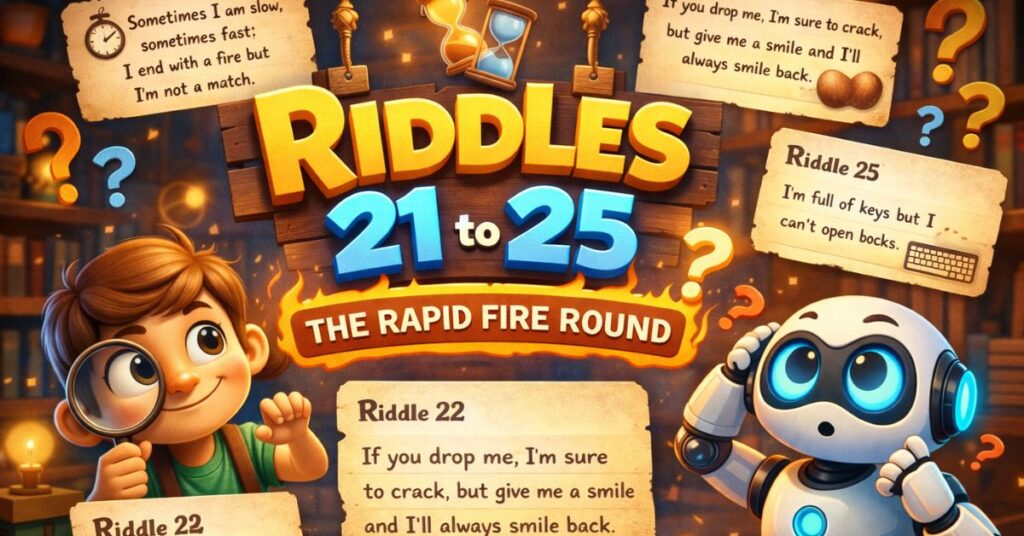
Riddles 21 to 25: The Rapid Fire Round
These final five riddles are designed to be delivered quickly — one after another — in a game format. Time your child and see how fast they can work through the set. Speed matters here, because quick thinking under mild pressure is exactly the cognitive state that builds mental flexibility.
⏱️
21-25 Final Speed Challenge (Read Mode)
Show Questions ▾
Riddle 21: If there are three apples and you take away two, how many apples do YOU have?
Answer: B) Two | AI Lesson: You took two apples. You have two. Precision reading test.
Riddle 22: What has keys but no locks, space but no room, and you can enter but cannot go inside?
Answer: B) A keyboard | AI Lesson: Multiple meanings of words like keys and enter.
Riddle 23: A plane crashes on the border of Canada and the USA. Where do they bury the survivors?
Answer: D) You do not bury survivors | AI Lesson: Survivors are alive! Tests careful listening.
Riddle 24: What is the next letter in this sequence: J, F, M, A, M, J, J, A, S, O, N, ?
Answer: B) D — December | AI Lesson: First letters of months. Pattern recognition.
Riddle 25: A man builds a house where all four walls face south. A bear walks past. What colour is it?
Answer: C) White — polar bear | AI Lesson: Only at North Pole can walls face south. Logic reasoning.
⚡ SPEED CHALLENGE
Solve the final 5 logic traps. Sahi ya Galat ka turant pata chalega!
RIDDLE 21/25TIME: 40s
Why These Riddles Matter for AI Literacy
It is worth stepping back and explaining why we built this collection the way we did — because the goal is bigger than just keeping kids entertained for an afternoon.
Every riddle in this guide targets a specific cognitive skill that has direct relevance to how AI systems work. When a child solves Riddle 12 about the AI president question, they are not just cracking a puzzle. They are learning about knowledge cutoffs — a real engineering concept that affects how every chatbot in the world operates.
When a child solves Riddle 3 about the doctor, they are learning about bias in assumptions — the same kind of bias that AI engineers spend millions of dollars trying to identify and remove from their training datasets.
This is what we mean when we talk about AI literacy. It is not about teaching children to use AI tools. It is about teaching them to understand AI systems well enough to question them, evaluate their outputs, and eventually improve them.
The Thinking Skills These Riddles Build
Solving these puzzles helps children develop the foundational cognitive architecture required for AI engineering and data science.
🎯
Precision Reading
🌀
Lateral Thinking
🧩
Analogical Reasoning
🔍
Pattern Recognition
⚠️
Assumption Awareness
🗣️
Linguistic Flexibility
🤖
Embodied Reasoning
⛓️
Multi-step Logic
How to Use These Riddles at Home
You do not need to run through all 25 in one sitting. In fact, we recommend against it. The best approach is to treat these riddles as conversation starters rather than a quiz.
Pick one riddle. Read it out loud. Then, before your child answers, ask them: ‘What information do you already know that helps you here?’ This simple question transforms a guessing game into a thinking exercise.
When your child gets a riddle wrong, resist the urge to immediately reveal the answer. Instead, give one clue. Let them sit with the discomfort of not knowing for a moment. That discomfort — the feeling of a puzzle not yet solved — is exactly where real learning happens.
And when they get one right, ask them to explain their reasoning. ‘How did you figure that out?’ is one of the most powerful questions a parent or teacher can ask. It forces metacognition — thinking about your own thinking — which is the foundation of all advanced learning.
📅
Recommended Age Guide
Tailor your learning experience based on your child’s current development level.
Ages 7+
Sections 1 & 2
Riddles 1-10: Perfect for early logic building.
Ages 9+
Section 3
Riddles 11-15: Introducing complex AI concepts.
Ages 10+
Section 4
Riddles 16-25: For advanced digital thinkers.
All Ages
Rapid Fire Round
Best enjoyed with a parent for extra fun!
Conclusion: The Children Who Ask Why
There is a particular kind of child who, when shown a magic trick, does not just clap. They lean forward and ask: ‘How did you do that?’
That curiosity — the refusal to accept the output without understanding the process — is the most important quality a future technologist can have. These riddles are designed to encourage exactly that kind of thinking.
The goal is not to make children afraid of AI or dismissive of it. The goal is to help them grow up as informed, confident, and curious people who can use AI as a tool rather than being used by it.
Start with one riddle tonight. See where the conversation goes. You might be surprised how much your child already knows — and how much they are ready to discover.
Continue Your AI Journey at N4GM
Ready for more challenges? Explore our curated collections designed for the 2026 AI Era.
Sachin Sharma is a Tech AI Writer and Chief Editor at N4GM.com, simplifying how AI is transforming education and smart learning since 2019. With deep SEO expertise, he delivers reliable insights on AI learning tools and EdTech trends, helping students and educators navigate the future of technology.